Biography - Saddam Hussein
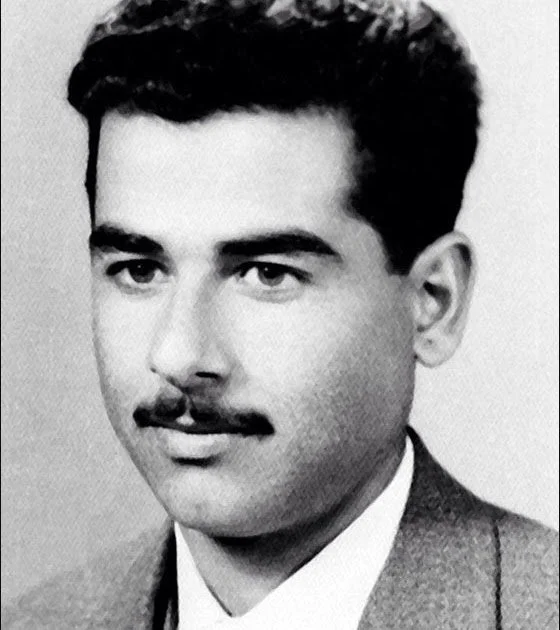
Originally written as copy for a YouTube history series
Saddam Hussein ruled Iraq from 1979 until his death in 2006. A brutal dictator, Hussein used the profits of Iraq's oil industry to create a military state in which he could crush all opposition. However, a decade of military failures in the '80s and early '90s led to the US-backed invasion and his execution for crime against humanity.
*****
Saddam Hussein Abd al-Majid al-Trikriti was born in a time of upheaval in Arab identity and politics. Following decades of European occupation that followed the First World War, the new Ba'athist ideology promoted the idea of a pan-Arabic state and a renaissance of Arab culture.
Heavily influenced by the uncle who raised him, Hussein became active in the newly founded, revolutionary Ba'ath Party.
His first significant political moment came in 1959 when he took part in the failed assassination of General Abd al-Karim Qasim. He then fled to Syria and then Egypt, returning in 1963 only to be arrested for plotting to assassinate the new President, Abdul Salam Arif.
In 1966, Saddam escaped jail and began to work his way up the ranks of the Ba'ath party. In 1968, Ahmed Hassan al-Bakr seized power, and Saddam Hussein was named as his deputy. However, he quickly became the de-facto power behind the throne.
Then in 1979, Hussein pushed out al-Bakr to become President.
*****
Determined not to allow the same kind of coup that had put the last four rulers of Iraq in power - including himself - Saddam quickly moved to suppress opposition.
The 1973 energy crisis had created massive oil revenues, which throughout the '70s Hussein had invested in public infrastructure. He oversaw the building of new roads, the electrification of towns, farm subsidies, creation of a state of the art public health system, and a campaign to eradicate illiteracy. Hussein also made sure he received all the credit.
At the same time, Hussein invested heavily in Iraq’s security services, creating the apparatus to locate and eliminate any and all opponents to his rule.
*****
Despite the Ba'athist ideal of Arab unity, Hussein quick fell out with other Arab states. He saw Egypt's peace treaty with Israel as a betrayal, and the Islamic Revolution led him to fear Iran's influence on his secular authority.
In 1980, as a show of strength, Hussein ordered the invasion of Iran, a move that quickly backfired. After making some quick initial gains, Iran soon forced Iraq into a bloody war of attrition that would last eight years.
In 1982, Saddam attempted to sue for peace, only for Iran to refuse. When Health Minister Dr Ruyadh Ibrahim suggested Hussein might step down as a gesture of peace, Hussein had him arrested. The following day, pieces of Ibrahim's dismembered body were delivered to his wife.
The stalemate continued until 1988. It was during this time, Saddam first began ordering the use of chemical weapons. It's estimated up to 100,000 Iranian soldiers were killed or suffered long-term injury from chemical weapons such as nerve gas. No one knows how many civilians were injured.
*****
In the following years, Hussein found himself with $30 Billion in war debt. In 1990, he ordered his oil-rich neighbour Kuwait to cut back on production to drive up global oil prices. When Kuwait refused, Saddam invaded.
However, this attempt to destabilise the international oil supply turned out to be a step too far. In 1991 a US-led coalition, with support from many Arabic countries, invaded Iraqi and liberated Kuwait.
*****
Over the next decade, Saddam attempted to reinforce his image as a strong ruler.
In 1991, between 100,000 and 180,000 civilians were killed around the country as uprisings and protests at Hussein's military failures were violently suppressed.
In the meantime, in an attempt to appease the country's religious factions, Iraq's state media began to portray Hussein as a devout Muslim. He even went so far as to have a copy of the Qur'an written in his own blood.
In 1995 and 2002, Iraq held referendums on whether the public approved of Hussein's job as President. He received a preposterous 99.96% and 100% approval rating, respectively.
*****
US and Western hostility remained high, and in 2003 the US invaded Iraqi. Severely weakened in the preceding two decades, the Iraqi military collapsed within three weeks. Hussein went into hiding, but was found ten months later hiding in an underground bunker near a farmhouse in ad-Dawr.
While the initial pretext of Hussein having stockpiles of weapons of mass destruction turned out to be untrue, in June of 2004, US authorities handed Saddam Hussein over the interim Iraqi government to stand trial for crime against humanity.
The trial did not go smoothly, as might have been expected. Saddam continually defied the authority of the court. He even threatened to go on a hunger strike in protest at the lack of protection his legal team were being provided.
On 5th November 2006, Saddam Hussein was sentenced to death by hanging. On 30th December 2006, the sentence was carried out. He was buried in the town of his birth the following day.